
Plasma Cutting at a Glance
- ApplicationCarbon, low & high alloy
- Carbon steelUp to 64 mm
- Stainless steelUp to 50 mm
- Cutting area15000 × 3000
Taken from the page; see the note on units. Confirm the capacity for your material and part at quotation.
Our flame cutting profiling service does not extend to cutting such materials as stainless steel. This is because flame cutting relies on the oxidation process whilst materials such as stainless, aluminium and copper form an oxide which makes the flame cutting of this material virtually impossible. Plasma arc cutting is one alternative that should be considered as a suitable cutting method.
Reading the text: Champak Industries’ flame (oxy-fuel) cutting service does not cover stainless steel. Flame cutting works by oxidation, and stainless steel, aluminium and copper form an oxide that stops it, so plasma is the alternative for them.
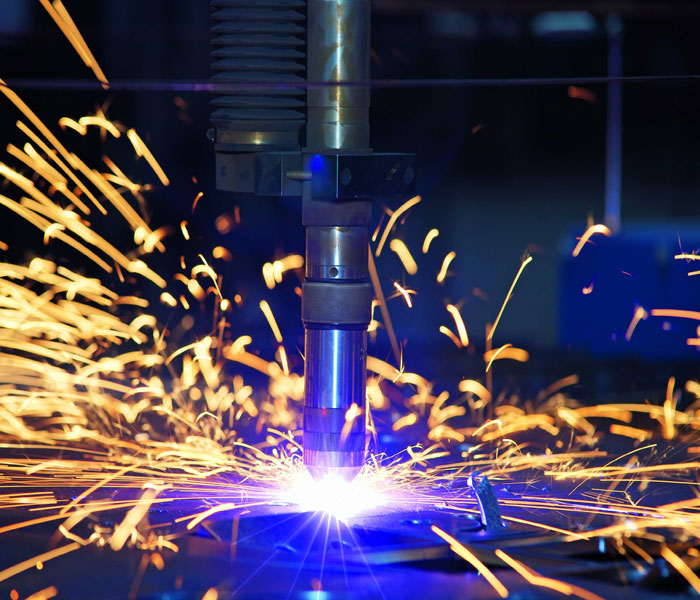
The process involves gas being passed through a narrow nozzle at high velocity which is connected to an electric current which creates an ionised plasma stream. This stream melts the metal whilst any molten material is blown away by the high velocity gas resulting in a cut edge.
Champak Industries offer a plasma cutting profiling service for stainless and other high alloy steels – please refer to our technical information below…
Our Plasma Cutting Services
- Application: Carbon, Low & High Alloy Steels
- Cutting Range: Up to 64mm (carbon), up to 50mm (stainless)
- Cutting Area: 15000 x 3000
Units: The cutting range and cutting area carry no units on the page. Read the range as millimetres and the area as 15000 × 3000 mm, which is 15 m × 3 m. The Wear Classifier & Blade Cutting page lists a larger capacity, so confirm the capacity for your part.
Plasma or Flame Cutting?
| Process | How it cuts | Suits (from the page) |
|---|---|---|
| Plasma arc | An ionised gas stream melts the metal and high-velocity gas blows the molten metal away | Stainless and other high alloy steels, and carbon and low alloy steels |
| Flame (oxy-fuel) | Relies on oxidation of the metal | Not stainless steel, aluminium or copper, because they form an oxide that prevents flame cutting |
Based on the page’s own explanation. Thermal cutting leaves a heat-affected edge; for hardened plate see the cutting notes on Wear Resistant Plates.
How the Five Cutting Services Differ
Champak Industries lists five cutting and wear-part services. The table summarises each from its own page; the capacities are as each page states them.
| Service | What it covers | Capacity or use (from the pages) |
|---|---|---|
| PLASMA (this page) | Plasma profile cutting of carbon, low and high alloy steels | Up to 64 mm carbon and 50 mm stainless; cutting area 15000 × 3000 |
| WEAR PLATE CUTTING | Cutting wear and high-strength plate, full sheets or cut to order | Plate from 3 mm to 4 in thick |
| LINERS | Wear liners made from 400 HB and 500 HB plate for bulk-handling conveyors | Conveyor, skirt and loading-area liners |
| BLADES | Classifier and blade parts, with CNC plasma profile capabilities listed | Up to 300 mm thick, 12000 mm long, 3500 mm wide |
| WEAR STEELS | AR 400 / 500 and HB 400 / 500 wear plate, chute and wear-resistant liners | Dump bodies, conveyors, chutes, crushers, mining |
The Plasma Cutting page and the Wear Classifier & Blade Cutting page list different plasma capacities. Confirm the thickness, size and material of your part when you send the drawing. See Cutting Services for the overview.
What to Send for a Plasma Cutting Quotation
| Item | What to include |
|---|---|
| Drawing | PDF, DWG or DXF with dimensions, hole positions and tolerances |
| Material | Grade and standard, for example AR 400, S690QL or ASTM A387 Gr 11 |
| Thickness and quantity | Plate thickness in mm and the number of parts or total weight |
| Edge requirement | Plain cut edge, bevel for welding or other edge preparation |
| Supply | Plate supplied by Champak Industries, or free-issue plate |
| Delivery | Destination, required date, packing and marking instructions |
Plasma Cutting: Frequently Asked Questions
01What can the plasma cutting service cut?
The page lists carbon, low and high alloy steels, up to 64 mm in carbon steel and 50 mm in stainless steel, in a cutting area of 15000 × 3000.
02Why is stainless steel plasma cut rather than flame cut?
Flame cutting relies on oxidation, while stainless steel, aluminium and copper form an oxide that stops the flame; plasma arc cutting is the alternative.
03How does plasma cutting work?
Gas passes through a narrow nozzle at high velocity and an electric current turns it into an ionised plasma stream, which melts the metal while the gas blows the molten metal away.
04Does the cutting area carry units?
No. Read the 15000 × 3000 cutting area as millimetres, and confirm the capacity for your part.
05Does the blade cutting page list a different capacity?
Yes, up to 300 mm thickness, 12000 mm length and 3500 mm width, so confirm the capacity for your material and part.
06What should I send for a quotation?
A drawing in PDF, DWG or DXF, the material grade and thickness, quantity, edge requirement, and the delivery destination and date.
07Can the edge be prepared for welding?
State any bevel on the drawing; the blade cutting page lists a dual-head beveling system for straight and contour bevels, so confirm which equipment applies.
08How do I get a quotation?
Send the drawing, material and grade, thickness, quantity, destination and required date through the enquiry form, by WhatsApp or by phone on 0982 0944 724.